Life as a disciplined clock

2026-07-05
model: gpt-image-2
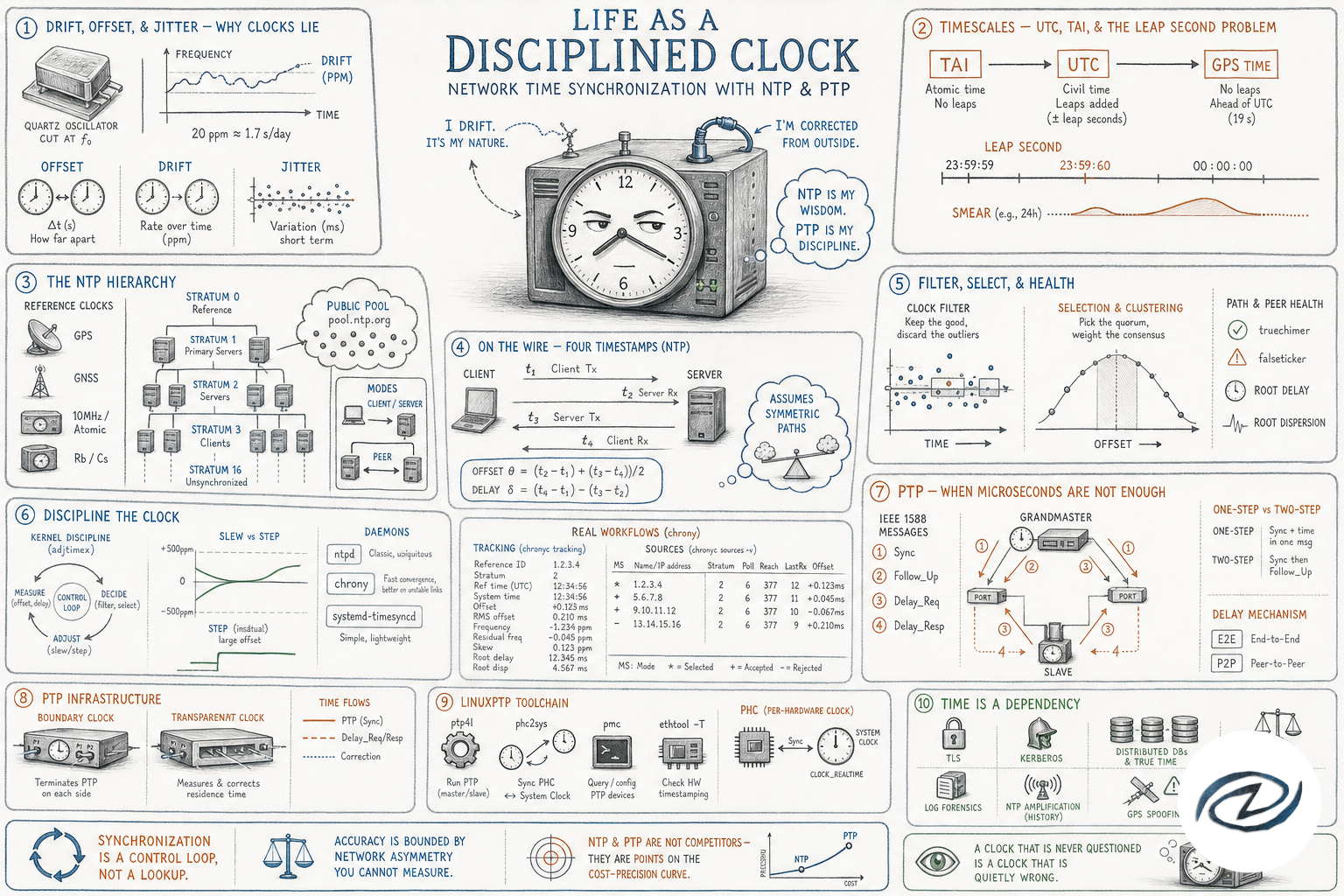
Life as a disciplined clock
Network time synchronization with NTP and PTP

Network time synchronization with NTP and PTP

  • Drift, offset, and jitter — why clocks lie
  • Timescales — UTC, TAI, and the leap second problem
  • The NTP hierarchy — strata, pools, and reference clocks
  • The wire algorithm — four timestamps against an asymmetric network
  • Discipline — slewing, stepping, and the daemons that do it
  • PTP — when microseconds are not enough
  • PTP infrastructure — boundary clocks, transparent clocks, and linuxptp
  • Trust, attacks, and why everything needs the right time
Life as a disciplined clock

scroll to zoom · click outside image to close

Generation prompt

Pencil sketch base with selective colored ink traits. Fine graphite lines for structure and shading; specific edges, connectors, or key details rendered as deliberate strokes of colored ink pen in sober muted tones (slate blue, terracotta, sage, or warm sepia — one or two colors at most). White or transparent background. Composition is slightly surrealist but restrained — technically accurate subject matter placed in quietly unexpected spatial relationships or with calm dreamlike proportions, closer to Magritte or De Chirico than Dali. Composed, not chaotic. Create a polished wide infographic visual for "Life as a disciplined clock" about Network time synchronization with NTP and PTP. Context: Treat the reader as a peer. The narrator is the system clock of a production server: it drifts by construction, it is corrected from outside, and it has opinions about both. Give a complete overview of network time synchronization: why quartz oscillators drift and what ppm means operationally, offset versus drift versus jitter, wall versus monotonic clocks, UTC, TAI, GPS time, leap seconds and smearing, the NTP stratum hierarchy, reference clocks, the public pool, client/server and peer modes, the four-timestamp offset and delay calculation and its symmetric-path assumption, clock filter, selection and clustering, truechimers and falsetickers, root delay and dispersion, kernel clock discipline via adjtimex, slewing versus stepping, ntpd versus chrony versus systemd-timesyncd with real chronyc tracking/sources workflows, then PTP: IEEE 1588, hardware timestamping at the PHY, grandmaster and BMCA, Sync/Follow_Up/Delay_Req message flow, one-step versus two-step, E2E versus P2P delay, boundary and transparent clocks, PTP profiles including telecom and White Rabbit, the PHC and the linuxptp toolchain (ptp4l, phc2sys, pmc, ethtool -T). Close with time as a dependency: TLS, Kerberos, distributed databases and TrueTime, MiFID II, log forensics, NTP amplification history, GPS spoofing, and NTS. Emphasize the systems logic throughout: synchronization is a control loop, not a lookup; accuracy is bounded by network asymmetry you cannot measure; NTP and PTP are not competitors but different points on the cost-precision curve; and a clock that is never questioned is a clock that is quietly wrong.. Key points to visualize: Drift, offset, and jitter — why clocks lie; Timescales — UTC, TAI, and the leap second problem; The NTP hierarchy — strata, pools, and reference clocks; The wire algorithm — four timestamps against an asymmetric network; Discipline — slewing, stepping, and the daemons that do it; PTP — when microseconds are not enough; PTP infrastructure — boundary clocks, transparent clocks, and linuxptp; Trust, attacks, and why everything needs the right time. Use concise labels only; avoid paragraphs and tiny text. Leave the detailed explanatory copy to the surrounding HTML page.